Showing posts with label Barry Eichengreen. Show all posts

Tuesday, February 7

2012 Prediction #4: Romney Will Not Win the U.S. Presidency

It's looking like Romney has the Republican nomination, but I am very doubtful that he can carry the country in 2012 for a whole variety of reasons:
  1. U.S. economic figures are showing signs of life, at just the right time.
  2. Like Eichengreen, Dalio, and others, I think the next leg down in the ongoing financial crisis won't make landfall until 2013 at the earliest.
  3. There is a decided lack of enthusiasm about Romney. He comes across as a Wall St. guy who, policy wise, isn't all that different from Obama. He also isn't well liked by the Republican base. In short, Romney seems positioned somewhere in political no-man's land.
  4. There is a reasonable chance for a third party candidate to be a factor, and should that happen it will work against Romney more than Obama.
  5. Even if Eurogeddon boils over the world's central banks have plenty of space to deploy more monetary artillery. Central banker hands won't begin to be tied until core inflation starts to increase significantly, and that's unlikely to happen over the next 10 months. Even though Bernanke was appointed originally by a Republican, he would probably prefer that Obama (who reappointed him) be reelected given Romney's and general Republican hostility towards the Fed.
  6. An Iranian conflict (perhaps the biggest X-factor in 2012) likely favors the incumbent as it would provide Obama with an opportunity to exercise leadership and look presidential.
What could upset this prediction is any material economic deterioration or a geopolitical flub by Obama.

Thursday, November 10

Euro Reading Roundup - Who Will Be Getting Booted Out of the Eurozone?

Or perhaps the more important question is which country will be the first to experience a a more serious bank run than the slow motion runs which have been occurring in Greece, Ireland, and Italy?

1. Departures from the Eurozone are "inevitable" (Rodrik)

2. Europe's Darkness at Noon (Eichengreen)

3. Thinking Through the Unthinkable (Wolf)

4. 'In 31 years, I've never seen markets this crazy' (Jim Cramer)

5. Wall Street Ignoring Europe? (Tim Duy) Smells like 2007

Friday, September 9

End Game: Greece to Default This Weekend?

While the Greek government is publicly denying it (I suppose they have to until the banks close) the game appears to be up (further confirmation from Spiegel here).

The timing of the default would come roughly in line with my prediction. We're also seeing a softening in the euro, now down to $1.36, also as predicted.

In terms of what happens next, the first step following default would likely be a bank holiday in Greece. This would then be followed by some type of devaluation (rumoured to be around 50%) of the reintroduced drachma.

As I posted yesterday, anyone in Greece who still has their euros in a Greek bank may want to move swiftly.

Here is Professor Eichengreen with some deeper perspective and why its likely the ECB is going to be doing a lot of Ctrl+P.

Friday, July 22

Video: Barry Eichengreen on Why Economics Needs History

Berkeley Professor Barry Eichengreen discusses the importance of history to the study of economics and other topics in the below video.


A summary of Professor Eichengreen's recent book, Exorbitant Privilege, can be found here; a video lecture he gave on this book can be viewed here

So far Germany's current generation of leaders seem to be as committed to supporting the current Eurozone project as Professor Eichengreen has suggested they would . However, it's less than clear to me whether Germany has the appetite or capacity to support countries such as Spain and Italy should a full blown debt crisis ignite in these two large countries. Perhaps Germany would prefer a smaller Eurozone, comprised primarily of more economically homogeneous northern European countries instead of the current version which includes slow growing Club Med countries?

Saturday, January 22

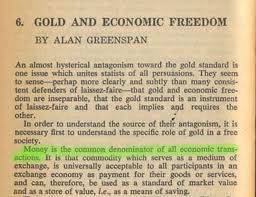
Greenspan's Opinion on the Gold Standard and Where's Gold Heading Now?

Some choice comments on gold from the former Federal Reserve Chairman previously made on Fox Business News:
"We have at this particular stage a fiat money which is essentially money printed by a government and it's usually a central bank which is authorized to do so. Some mechanism has got to be in place that restricts the amount of money which is produced, either a gold standard or a currency board, because unless you do that all of history suggest that inflation will take hold with very deleterious effects on economic activity. There are numbers of us, myself included, who strongly believe that we did very well in the 1870 to 1914 period with an international gold standard." 
During the interview Greenspan also wondered aloud whether we really need a central bank.

Contrary to what the occasionally conspiratorial and always hyperbolic 'Tyler Durden(s)' of ZeroHedge would have you believe, these quotes (while perhaps deserving of a muted 'wow' from those hearing them for the first time) aren't nearly as big of a surprise as World Bank President Bob Zoellick's recent call for a return to the Gold Standard.

Throughout his career Greenspan hasn't exactly been shy about making his feelings about Au known. Further, Greenspan is a highly paid private consultant right now without any official government responsibilities or gag orders. He (and his clients) are no doubt aware that his words still carry significant weight in the marketplace, and he can say whatever he likes and even talk his own book.

Having said that, as a close student of Greenspan's philosophy and personality I can say with a high degree of certainty that he very much cares about his place in history, particularly at this stage in his career.

In other words, the likelihood that the former Chairman is going on television and talking up gold the past few years just to earn a few bucks from hedge funds is low, in my opinion. And with outgoing Fed Governor Thomas Hoenig also recently weighing in on the yellow metal's merits one can't help notice the growing chorus for a reconsideration of the gold standard.

Continue reading the full article published on SeekingAlpha here.

Sunday, January 16

U.S. Debt Interest Payments to Surpass Defense Expenditures Within Decade

The Congressional Budget Office is estimating that annual interest payments on federal debt will more than double over the next decade to $778 billion.

Put another way, the U.S. will soon be paying federal debt interest (much of it to Asian and Middle East creditors) equal to the U.S.'s annual defense budget.

What assumptions lay behind the CBO's estimates? From the WSJ:
In 2010, it (the U.S. federal government) paid an average of about 0.1% interest on 3-month Treasury bills, and 3% on ten-year notes. Total net payments amounted to $197 billion, or 1.4% of annual economic output. That’s a bit more than what the government spent on unemployment insurance.
Low interest rates, however, won’t last forever — assuming the U.S. economy doesn’t succumb to long-term, Japanese-style stagnation. The CBO estimates that interest rates on 3-month bills and 10-year notes will reach 5.0% and 5.9%, respectively, by 2020. That, together with a rapidly rising debt load, would cause annual net interest payments to more than double by 2020 — to $778 billion, or a record 3.4% of GDP.
As bad as that sounds, I believe the CBO could be painting an overly optimistic scenario.

Whether the U.S. will actually be able to borrow long-term at a (historically) relatively low 5-6% interest rate in a decade's time is pure speculation by the CBO.

I'd also like to better understand why the CBO is projecting that U.S. interest rates across the yield curve will dramatically flatten? Right now the U.S. pays an interest rate of roughly 0.15% on 3-month borrowings, while the 10-year note is yielding 3.32%, for a difference of over 3% between short-term and longer-term borrowings. That's a pretty significant difference compared between the current level and the 0.9% difference the CBO is projecting in 2020.

If the U.S. continues its current debt trajectory is it reasonable to assume that it will be able to borrow long-term at a mere couple percentage points higher than today's levels?

Professor Barry Eichengreen is predicting that emerging financial powerhouses, such as China, will be able to offer a reserve currency alternative to the U.S. Dollar by 2020. The U.S. is undoubtedly realizing lower interest rates right now due to the European sovereign debt crisis, and the lack of any real alternatives to the U.S. dollar as the world's primary reserve currency and the unparalleled liquidity of the U.S. treasuries market. What will happen when (not if) the situation changes?

Interest rates can certainly rise faster and/or higher than the CBO is projecting. A recalculation by the bond market of the U.S.'s credit worthiness can occur suddenly, as we saw last year with Greece. Professor Niall Ferguson for one is predicting that a U.S. fiscal crisis, similar to the one experienced by Greece last year, will occur within 2-4 years.

Thursday, January 6

Timing the Inevitable Decline of the U.S. Dollar

One of the most heavily debated macro topics is the future of the world's reserve currency, the seemingly almighty U.S. Dollar.

Neither the fact that scores of prognosticators have been predicting its demise for decades, nor that when the financial going gets tough (as it did during the 2008-2009 financial crisis) everyone wants it, has dissuaded today's dollar bears from taking a dim view of the greenback's future.

America's Exorbitant Privilege
Barry Eichengreen
Berkeley Professor Barry Eichengreen’s new book, Exorbitant Privilege, explains the U.S. Dollar's historic rise from international monetary obscurity prior to World War I, to surpassing British pound sterling in importance by 1924-25, to its dominant post-World War II position which it continues to occupy today.

Professor Eichengreen opens with the point that while we now live in a multi-polar economic world the financial system and monetary order still revolve around a single currency (the U.S. Dollar).

Some might be surprised to learn that approximately 75% of all $100 bills circulate outside the United States. The
 reserve currency holdings of the world's central banks are largely in U.S. Dollars or U.S. Dollar denominated assets (e.g., U.S. Treasuries).

What precisely is the 'Exorbitant Privilege' conferred on the United States by the special role its currency plays in the global financial system?

Professor Eichengreen calculates that the U.S. dollar’s status as the world's reserve currency is worth 3% in U.S. national income per year. In other words, having the world’s dominant reserve currency allows the U.S. to run an annual $500 billion current account deficit.

Some may remember Vice President Cheney's quip that "deficits don't matter", or Nixon Treasury Secretary Connally's response to foreign governments, critical of the U.S.’s profligate Vietnam and Great Society spending, on how the U.S. Dollar was "our currency, your problem". It is this 'Exorbitant Privilege', a term coined by French leaders in the 1960s who railed against the fact that American paper currency could be exchanged for "real stuff", which Professor Eichengreen views as unsustainable.

Are Reserve Currencies Analogous to Computer Operating Systems?

Economists explain the U.S. Dollar's rise and dominance through a principle called '
network externalities
' (or 'network effect'). Similar to how significant interoperability advantages in computing can be achieved through the adoption of a single operating system (e.g., Microsoft Windows), the widespread use of a single currency (the U.S. Dollar, and previously British pound sterling) can lead to mutually beneficial economic efficiencies.

However, in a world where 'Currency Converter' is one of the Top 10 most downloaded smartphone apps, determining exchange rates and making currency conversions can now be performed quickly and simply by a vast number of people. Just as the computing world is moving towards multiple operating systems (i.e., Windows, Mac, Linux, Google, iOS, etc.), Eichengreen believes the world will transition to three principal reserve currencies: the U.S. Dollar, the Euro, and the Chinese Renminbi (Yuan).

The Euro and the Renminbi: Assessing the U.S. Dollar Bridesmaids

On the currency topic du jour, Eichengreen believes that "euro gloom and doom is overdone". Just as a default by Los Angeles County won't spell the end of the U.S. Dollar, a default by Greece and/or Ireland won't bring about an end to the euro.

Germany is the one country, in Eichengreen's view, which could afford to abandon the euro without suffering catastrophic economic consequences. However, Eichengreen sees this as unlikely. Germany's next generation of leaders, while not having been around for the birth of the EU, are nevertheless heavily wedded to the European Project. Further, Germany benefits from a weaker euro via more competitive exports. If Germany were to leave the euro then the reintroduced Deutsche Mark would shoot up in value and risk choking off the German export led economic renaissance currently underway.

When it comes to the Chinese renminbi becoming a reserve currency, Eichengreen acknowledges that China needs to make significant changes. For starters, the renminbi will need to become freely convertible. China will also need to develop deep, liquid capital markets and make fundamental changes to its overall development model.

However, these and other changes may come quicker than many expect. A short time ago there were basically zero Chinese companies settling international transactions in renminbi; now 70,000 do so. Two U.S. multinational companies, McDonald's and Caterpillar, have issued renminbi-based bonds. Currently most of these changes are occurring in "China's financial petri dish" (Hong Kong), but China has set a target of making Shanghai a preeminent world financial center by 2020.

Timing the Decline of the U.S. Dollar?

Eichengreen assigns a very low probability to a sudden collapse of the U.S. Dollar. But could it happen? In short, the answer is yes.

A spat over Taiwan or rising tensions in the Asia Pacific over China building its first world class navy in 600 years could cause China to suddenly stop funding U.S. deficits. A more confident and assertive China is likely to continue to flex its newfound muscles, a subject I previously covered in more detail here.

However, what Harvard’s Larry Summers termed "The Financial Balance of Terror" is likely to prevent a catastrophic scenario from unfolding. Similar to how President Eisenhower threatened to dump the U.S.'s vast British bond holdings during the 1956 Suez crisis if British forces didn't leave the peninsula immediately (which they did), Eichengreen believes that China and U.S. officials will attempt to work out their differences through diplomatic back channels as opposed to openly fighting it out in financial markets.

A more likely scenario would be a sudden loss in investor confidence, like the one experienced by Greece last spring, in the U.S.'s ability to get a handle on government spending. Eichengreen notes how the ratio of U.S. federal debt (a relatively high 75% of GDP) vis-à-vis tax revenues (a relatively low 19% of GDP) is rapidly approaching the danger zone.

From an investment perspective, investors should continue to expect currency volatility under the current U.S. dollar dominated international monetary system. Further, the U.S. Dollar will continue to be the world's safe haven currency in times of crisis for the foreseeable future. However, according to Eichengreen a change in the international monetary order is all but inevitable within a decade.

Thursday, December 2

The Biggest Loser (Besides the Irish) in Ireland's Ongoing Debt Crisis

Noted economic historian Barry Eichengreen has written perhaps the most scathing damnation of this week's Irish bailout. I strongly encourage reading the full piece.

Professor Eichengreen takes aim at Germany in particular. In the below passage he compares the Irish bailout to Germany's own hopelessly burdensome WWI war reparations, which played a key role in the rise of the Nazis and perhaps the Great Depression:
"Ireland will be transferring nearly 10 per cent of its national income as reparations to the bondholders, year after painful year.This is not politically sustainable, as anyone who remembers Germany’s own experience with World War I reparations should know. A populist backlash is inevitable. The Commission, the ECB and the German Government have set the stage for a situation where Ireland’s new government, once formed early next year, rejects the budget negotiated by its predecessor. Do Mr. Trichet and Mrs. Merkel have a contingency plan for this?"
The short answer to Barry's question is, of course, no.

Irish Bailout Rejection Fallout

European sovereign bailouts may wind up becoming a lot like Department of Defense contracts in that the only thing contract signing signifies is the beginning (rather than the end) of negotiations. For example, if the new Irish government rejects its bailout as expected there may be an attempt to stem the ensuing crisis by negotiating down the hopelessly high bailout interest rate of 5.8% (or 7.25% depending on how it's calculated). And Ireland's controversial low corporate tax rate of 12.5%, rumored during the height of the drama  to be on the table for european 'harmonization', may also be revisited.

Any such renegotiations should be viewed as window dressing aimed at delaying the final reckoning. The fundamental problem is that Ireland is insolvent. No amount of additional liquidity or tax rate bargaining alters this inescapable fact. Faced with this prospect, Europe's current leaders are struggling to determine who will take the biggest hit from Ireland's inevitable default.

Who Will Be the Biggest Loser?

Arguably the key issue to keep an eye on is whether senior Irish bank debt holders will be forced to take losses. If in fact Eichengreen's suggestion of 100% haircuts on insolvent Irish bank debt is adopted the ramifications for Europe's banking system would be difficult to overstate.

The below chart is helpful to understanding the implications of an Irish bailout rejection/and or default.

(click to enlarge)

The U.K. is Ireland's largest creditor with approximately $220 billion in exposure, so any Irish bailout rejection and/or default will weigh heaviest on Britain. Royal Bank of Scotland (RBS) and Lloyds TSB, which were previously placed on government life support, are particularly threatened.

An Irish rejection of the bailout will put substantial pressure on the still fragile British banking system, which post-bailout consolidation is now home to three of the world's five largest banks (including #1 RBS).

(click to enlarge)

In spite of the current austerity push in the U.K., the government participated in the Irish bailout and pledged approximately $10M to "a friend in need". An Irish Times editorial, reflecting the long and conflicted relationship between these two nations, greeted British 'kindness' with a degree of skepticism.

It's would appear that the U.K. (an EU member which never adopted the euro currency) helped bailout Ireland because rescuing a neighbor is politically more palatable than what would have been necessary if Ireland's debt situation had further deteriorated: recapitalizing the British banking sector (again).

A Lonely Lady

But if at some point an Irish default is inevitable, and the Eurozone nations align to protect their euro based banking system, Britain may well find itself the odd man out. And since further bank bailouts by parliament are politically DOA, Mervyn King and the Old Lady of Threadneedle Street may be left to step into the breach to recapitalize British banks. Any such Bank of England support would be coming on top of calls from the Cameron government for further quantitative easing to reduce the effects of government budget cuts and nagging inflation. In other words, sterling would be forced to do even more at a time when the currency is already stretched thin.

It is worth briefly reviewing the history of pound sterling in the 20th century. In the 1920s one pound fetched almost $5. The country was forced off the gold standard during the September 1931 Sterling Crisis, resulting in a sharp devaluation. Following the massive accumulation of debt during WWII, the pound was devalued again in 1948. This was followed by a further 15% devaluation in 1967. Following a severe recession in the early 1980s, the pound has traded as low as $1.03 in March 1985. Overall, there is well established history of devaluation when the going gets tricky.

While the recent plunge in the euro has provided a relative respite in what had been a steady weakening trend in the pound, Britain will bear the foreign brunt of any Irish bailout rejection and/or default. Further compounding this problem is China's curious financial support to Europe's 'Club Med' nations, but not Ireland, and Britain's total debt position which stands at a whopping 5x GDP (the world's largest total debt/GDP ratio). Based on these and other factors one can make a very good argument that over the medium-to-longer term the pound will continue its long drift downwards. Several ETFs are available to hedge against this risk.

Saturday, November 27

“We’re not Greece!” “We’re not Ireland!” “We’re not Portugal!”

While the name of the country changes, the "We're not _____!" plea from a revolving panoply of European officials has become all too familiar.

Can any of Europe's politicians -- or anyone at all -- definitively state at which country's doorstep the rolling European debt crisis will ultimately stop? The short answer is no.

Europe's Two Big Challenges

The Economist has a comprehensive summary of the latest developments in this sad saga; the violence, which first turned deadly in Greece this spring, unfortunately shows no sign of abating in Ireland. From the article:
"[Germany's] Mrs Merkel and Mr Schäuble are continuing to insist on two proposals.
One is that the EU treaties must be amended to give permanent status to the European Financial Stability Facility. Without this, they say, the rescue fund will expire in 2013. But investors know from experience that treaty amendment is neither simple nor quick (it took years to push through the Lisbon treaty). Insistence on treaty change makes them nervous.
So, even more, does the second German demand: that future bail-outs must include debt-restructuring provisions to impose some losses (“haircuts”) on investors."
With respect to challenge #1, it is quite clear that Eurozone popularity is waning in certain quarters. Any treaty change could prove problematic, particularly in Ireland where such changes must be put to a referendum vote.

Europe's Web of Debt
On #2, haircuts to bondholders, it is worth taking another look at the complex edifice of european debt. The interlocking nature and size of cross-border debt holdings explains why European leaders fear allowing any one domino (Greece in May, Ireland this week) to fall.

Germany is the biggest checkbook in the EU and, quite understandably, is insisting that the private sector share in the cost of any future sovereign debt defaults. Otherwise what is the point of distinguishing between the debt of different countries?

But can Europe's delicately interwoven debt and banking market cope with haircuts, particularly to senior debt? The current Irish crisis was sparked by discussion of losses on subordinated debt (80% in the case of Allied Irish Bank). Tellingly, Irish debt costs have continued rising even after its bailout was confirmed. This is in part due to rumors that senior debt holders may also be forced to take losses.


As former chief IMF economist Simon Johnson and LSE's Peter Boone recently wrote "market participants are good at thinking backwards: if they can see where a Ponzi-type scheme ends, everything unravels". In other words, the market for troubled sovereign debt depends on the ability of countries like Ireland and Spain to 'roll over' their borrowings until their economies begin growing again. (Ireland's economy began shrinking again earlier this year, and Spain's is projected to shrink for 2010.) Without economic growth the odds that troubled sovereign debts will ever be repaid in full (without outside help) is almost certainly nil.

In the months since the spring Greek crisis, the quasi-explicit bailout guarantee by the "troika" (EU, IMF, and ECB) has been the Eurozone debt market's linchpin. Now the bond market is calculating that Germany's insistence on private sector loss sharing by 2013 means than holders of certainly Greek, Irish, Portuguese debt, and perhaps the debt of other nations, will be forced to incur losses. Instead of waiting  around to find out the precise haircut percentage, investors are exiting risky pan-european sovereign debt positions post-haste.

China to the Rescue?

Ultimately, the answer to the question of where the Euro-debt unmerry-go-round stops depends on how far the ECB, IMF and German taxpayers are willing to go.

Simon Johnson thinks the ECB and Germans neither can or will, respectively, step up to the plate. He also questions whether the IMF has enough resources to bailout a country the size of Spain, let alone Italy or France. He goes on to speculate that if one of the large Eurozone nations needs a bailout that China, with its $2.6 trillion in reserves, may be asked to recapitalize the IMF. The attraction for China: increased global standing and leverage on contentious issues, such as its policy of maintaining an artificially low currency.

I believe that China may expand its existing role in Europe's debt crisis. However, European and U.S. officials will be reluctant to surrender center stage to China and will minimize Beijing's participation. While the exact form of the ultimate resolution is unclear, it will be a European-U.S. led solution.

Looking Ahead

The question of whether membership in the euro currency union is a good idea has taken root. Iceland's President has recently been talking up his country's relatively quick bounce back from bankruptcy abyss. Part of Iceland's rebound can be explained by the fact that it was able to devalue its own currency, which helped its export sector. In contrast to Ireland, Iceland also chose not to bail out its insolvent banks. The Czech Republic, slated to become part of the currency bloc, recently demurred on whether it would follow Sweden's path of never adopting the euro.

On the subject of whether any countries will abandon the euro currency all together, the consensus view popularized by Professor Barry Eichengreen was that joining the euro was irreversible due to the risk of sparking a bank run. But as NY Times columnist Paul Krugman states, this incentive to keep the euro vanishes when a bank run (like the one currently underway in Ireland) has already taken place.

Many questions remain, but one thing is certain: even with Ireland's bailout (the specifics are expected to be announced on Sunday before Asian markets open) the Eurzone crisis is far from over. Investors looking to insulate themselves from events may want to consider hedging currency risk through various inverse Euro ETFs, or by investing in precious metals.