Showing posts with label Gold Price. Show all posts

Friday, September 14

Ben Bernanke Cannot Print a New Steve Jobs

Gold bulls rejoice, for open-ended QE is here!

Yesterday's Fed announcement wasn't the long rumored 'QE3', as a '3' implies a beginning and an end like the two prior rounds of quantitative easing.

The Fed has instead committed to not stop printing new money until the economy improves.

What then will the Fed do if the economy never improves, meaning unemployment never gets back below 5%? Will the Fed go on printing forever? We shall have to wait and see.

In the meantime anyone who believes that printing money ad infinitum will fix what ails the U.S. economy, or the global economy for that matter, is living in macroeconomic Willy Wonkaland.

Monetary policy in the form of printing new money and changing interest rates does very little if anything to improve the foundational competitiveness of an economy. The most dynamic economies are the ones which are the most productive and most innovative, and monetary policy has very little if any impact on these two areas.

The kind of GDP growth driven by purchases of products like Apple's iPhone reflects real economic growth. The kind of GDP growth derived from nominal GDP targeting (aka inflation) is fake.

In short, Ben Bernanke cannot create new real jobs. Real jobs are created by the Steve Jobs of the world.

However, it's much easier for central planners to punch a few buttons on a keyboard and print more money than to make the long-term adjustments necessary for fundamental economic improvement.

Thursday, February 9

Buffet Badmouthing Gold is Like Geithner Talking Up U.S. Dollar

Lebron hasn't been taking financial advice from this guy, I hope? 
The fact that Warren Buffet is not a gold fan is old news.

I can't help but think about how, similar to the notion that it's never a positive sign for the currency when a finance minister feels compelled to publicly defend it, that perhaps it's a bullish signal for gold whenever Buffet feels the need to diss the yellow metal.

If you've studied Buffet you know that he chooses his words with extreme care. His financial empire is also so entrenched in the global economy that the only real risks he faces are existential ones. Such as the semi-quiet, steady run which has been taking place on the U.S. dollar since the turn of the century, when gold began its secular move upward.

Oh how it must just eat at the Oracle to know that a rock has been outperforming his precious equities for well over a decade!

Buffet was arguably the biggest single beneficiary from the 2008 government bailouts, a fact which hasn't received much airtime from Buffet-friendly business journalists (I'm talking about you, Becky). The steady devaluation of fiat currencies, like the U.S. dollar, against gold is something that this blog projects will continue. It is also something which clearly Warren would like to see slow down by badmouthing gold.

Monday, February 6

2012 Prediction #3: The Gold 'Bubble' Will Not Burst This Year

George Soros has called gold the "ultimate bubble".

It's getting more than a little far along into 2012 to still be making predictions, but let me just state clearly that 2012 will not witness a collapse in the price of gold.

Why not? I've written about this at length previously, most recently here.

Gold is already off to a decent start in 2012, up $150/oz YTD, so it's perhaps a little unfair for me to be making this call in February. I'm also not making a call on whether gold will finish the year higher or lower, although I suspect higher. However, I am confident that we won't see the bottom fall out of the price of gold this year, or next for that matter.

Overall, we're somewhere in the middle innings of the fallout from the 2008 financial crisis and there is still way too much debt in the global financial system for the flight to gold to reverse.

Saturday, December 24

Recapping The PolyCapitalist's 2011 Predictions

For those keeping score three topics I made 2011 forecasts on were:
  1. Rise of Android
  2. China's bubble
  3. U.S. Housing
On Android, the verdict is in:


The U.S. housing market officially double dipped in May and then continued to fall, so that call looks correct as well.

The China prediction is a bit murkier, but here are some points worth noting:
  • The Hang Seng and Shanghai stock markets are in a bear market and down roughly 20% for the year, or 30% since May. From its peak in 2008 Shanghai is off 60%.
  • Housing prices are softening quickly; in Beijing new home prices dropped 35% in November alone.
  • Coastal cities such as Wenzhou and Ordos appear to be experiencing a credit crisis with reports of businessmen leaping off rooftops.
  • Hot money appears to be flowing out of the country: China's $3.2 trillion in foreign reserves have been falling for three months despite a trade surplus.
Things aren't shaping up too well for China or trade relations with the U.S. in 2012 either. For more on this see here, here, here and here.

Overall, does 2.5 out of 3 predictions sound about right?

Two more quick ones: bullishness on gold has been a steady theme since starting this blog in May 2010. And how did gold do in 2011? Despite the autumn selloff gold priced in U.S. dollars has returned around 10%. Not too shabby given that the S&P500 is flat YTD. I also managed a correct mid-year bearish call on the euro.

Check back later for The PolyCapitalist's 2012 predictions.

Wednesday, December 14

As the Euro Rolls Over, Why Hasn't Gold Rocketed?

In early May of this year, with the euro hovering in the $1.46-$1.48 range, I disagreed vehemently with euro bulls such as portfolio manager Axel Merk who argued that the common currency was no longer vulnerable to a sell-off (see Merk's May 11 FT article titled 'Dollar in graver danger than the euro' and my counter arguments here, here, and here). 

Merk's argument was basically that in 2010, when the euro sank to a low of $1.18, the currency served as a proxy for the sovereign debt crisis. Now, however, investors were shorting sovereign debt directly and, according to Merk, recognized that it is a lot harder for the ECB to print euros than it is for the Fed to print dollars.

For awhile, as you can see from the below chart, it appeared that Merk perhaps had made a good point. From May the euro has shown remarkable resilience; for the last six months one sovereign after another has white knuckled its way through uncertain debt auctions and ever higher interest expense. Meanwhile the ECB kept its 'bazooka' semi-holstered with purchases of sovereign debt apparently capped at €20 billion per week. While the euro did soften from mid-May onwards it was able to keep it's head above the $1.40 mark for the summer and a good chunk of autumn.

Click to enlarge

Continue reading the full article at Seeking Alpha here.

Sunday, October 23

Recommended links

1. Is there a shadowy plot behind gold? (FT)

2. Ray Dalio video interview (Charlie Rose). Ray doesn't have the most compelling television presence, but as the world's largest hedge fund manager he's clearly doing something right. Here is an interesting earlier read from the New Yorker on him and his firm, Bridgewater.

3. Eurozone summit - despair and backbiting in the corridors of power (Telegraph)

4. Steve Jobs Was Willing To 'Rip Off' Everyone Else... But Was Pissed About Android Copying iPhone? (TechDirt)

5. Michael Pettis Talks China (Infectious Greed)

6. €1.5bn Dexia loans used to buy shares in...Dexia (FT)

7. Generation X Doesn’t Want to Hear It (Emptypage)

Thursday, September 22

Is the Bernanke Put Kaput?

As Barry suggests, have we just seen the end of the Bernanke put? Based on the way markets are trading today it would appear Ken Rogoff was right that Bernanke doesn't have the stock market's back.

However, in all likelihood Soros is right about how policymaking powers-that-be will be forced to bailout Too Big To Fail banks should the financial system begin to teeter again. In which case the only real question is for how long can the current central bank shell-game be sustained in a low-to-no growth economic environment?

No one -- not Ben Bernanke, not Alan Greenspan, not Milton Friedman if he were alive, nobody -- knows for sure just how much more room the Fed's balance sheet has before non-negligible inflation kicks in. However, former Fed Chair Paul Volcker for one is starting to get nervous.


Federal Reserve Total Assets ($s Trillions)

(click to enlarge)

Continue reading the full article at SeekingAlpha here.

Tuesday, September 6

SNB Gift-Wraps $2,000/oz. Gold

Perhaps not since World Bank President Robert Zoellick publicly advocated a return to the gold standard last year has the barbarous relic received such a sure-fire price boost.

Today the Swiss National Bank declared that it will print an "unlimited" number of Swiss francs (because fiat central banks can do that) to prevent further appreciation of the franc.

The Swiss franc had been considered perhaps the ultimate safe haven currency, alongside perhaps to a lesser extent the Japanese yen. Both have been appreciating steadily over the past year+ in the face of periodic interventions by their respective central banks. Both countries have trade surpluses, which creates a built-in demand for their currencies as domestic firms repatriate funds. The Japanese and Swiss banking systems are also considered relatively strong. However with the SNB's decision to crank up the printing press and peg the franc to the euro at 1.20 francs will undoubtedly increase pressure on the Bank of Japan to do something similar.

Strangely, the price of gold dropped dramatically on the SNB news before rationality returned and pushed gold back up to an all-time record high of $1,923/oz. (although it did finish the day below $1,900).

Bottom line: today's news is very bullish for gold, and my prediction, made just under a month ago when gold reached $1,700/oz., that the yellow metal would push forward to $2,000/oz. should now materialize sooner than anticipated.

Monday, August 8

Gold Price: Full Steam Ahead to $2,000/oz.

Over a year ago, on May 6, 2010, this blog launched with a first post on the attractiveness of gold as an investment. On that day the price of gold was just under $1200/oz, and as it became clear that the Federal Reserve was about to embark on another large round of money printing, which later came to be known as QE2, I felt compelled to grab the keyboard and start typing (see articles tagged 'Gold' both here and on SeekingAlpha for further reference).

During this time it has been amusing to watch the professional punditry drone on about a  "gold bubble" and observe various blogger bets about how gold's run couldn't last. The biggest amusement of all, however, has been the disparaging remarks from those such as Berkshire Hathaway's Charlie Munger, who belongs to a group I've taken to calling the 'gold haters'.

Suggestions from credible policymakers, such as the World Bank's Robert Zoellick advocating a return to the gold standard, have lit a fire under the barbarous relic's price this past year. Today, with gold pressing above $1700, or nearly 50% higher in just over a year, I can't help but comment on how we've heard nary a peep of late from the anti-gold crowd.

Where to from here? As long as three key fundamental forces persist then the rise in the price of gold will continue unabated. Those forces are:
  1. Low interest rates, a hallmark of the current program of financial repression, which is only just getting started and should extend for many years to come.
  2. Continued central bank purchases of gold by countries such as South Korea, Thailand, Russia, etc.
  3. More money printing, which we've seen in spades of late with Italian and Spanish bond buying, Bank of Japan and Swiss National Bank currency intervention, and the Fed's rumored QE3.
Continue reading the full article at SeekingAlpha here.

Thursday, June 23

Video: Jim Grant - 'We Traded the Gold Standard for the PhD Standard'

Interview with Jim Grant on Bernanke's press conference today, the coming of QE3, and why the Federal Reserve should "be run by someone with a degree in unintended consequences" after the break.

Monday, May 16

Time for the U.S. to Sell Fort Knox Gold?

Some members of Congress and economists are saying it's time to cash-in on the appreciation of the U.S.'s vast gold holdings, which were recently valued at $370 billion.

From the Washington Post:
Although the country does not use the gold for anything, Treasury officials believe that selling it could create the impression of desperation, and thereby rattle the markets. Inert though it may be, the mountain of hidden gold may serve an indefinable psychological function.
Selling it during a budget crunch would seem a sure bet to incite derision. The satirical newspaper The Onion recently ran a story in which President Obama vowed to balance the budget through spending cuts, tax increases and a daring midnight heist of Fort Knox. (“I’ve got the blueprints and I think I found a way out through a drainage pipe.”) 
Of course, Gordon Brown's U.K. government had a similar idea about selling England's gold, and we've seen how well that worked out.

Saturday, January 22

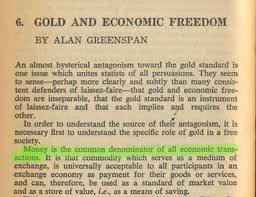
Greenspan's Opinion on the Gold Standard and Where's Gold Heading Now?

Some choice comments on gold from the former Federal Reserve Chairman previously made on Fox Business News:
"We have at this particular stage a fiat money which is essentially money printed by a government and it's usually a central bank which is authorized to do so. Some mechanism has got to be in place that restricts the amount of money which is produced, either a gold standard or a currency board, because unless you do that all of history suggest that inflation will take hold with very deleterious effects on economic activity. There are numbers of us, myself included, who strongly believe that we did very well in the 1870 to 1914 period with an international gold standard." 
During the interview Greenspan also wondered aloud whether we really need a central bank.

Contrary to what the occasionally conspiratorial and always hyperbolic 'Tyler Durden(s)' of ZeroHedge would have you believe, these quotes (while perhaps deserving of a muted 'wow' from those hearing them for the first time) aren't nearly as big of a surprise as World Bank President Bob Zoellick's recent call for a return to the Gold Standard.

Throughout his career Greenspan hasn't exactly been shy about making his feelings about Au known. Further, Greenspan is a highly paid private consultant right now without any official government responsibilities or gag orders. He (and his clients) are no doubt aware that his words still carry significant weight in the marketplace, and he can say whatever he likes and even talk his own book.

Having said that, as a close student of Greenspan's philosophy and personality I can say with a high degree of certainty that he very much cares about his place in history, particularly at this stage in his career.

In other words, the likelihood that the former Chairman is going on television and talking up gold the past few years just to earn a few bucks from hedge funds is low, in my opinion. And with outgoing Fed Governor Thomas Hoenig also recently weighing in on the yellow metal's merits one can't help notice the growing chorus for a reconsideration of the gold standard.

Continue reading the full article published on SeekingAlpha here.

Saturday, January 15

Quote of the Day: Jim Rogers On Why He's Long Cotton

From legendary investor Jim Rogers:
“Paper money is made of cotton, and I’m long cotton, by the way,” Rogers said. “One reason I’m long cotton is because Dr. Bernanke is out there running the printing presses as fast as he can.”
More from Rogers, including his thoughts on gold, can be found here.

Wednesday, December 8

Video: David Einhorn Media Blitz Continues on Charlie Rose

It's the David Einhorn show this week. His first ever interview on Charlie Rose from yesterday can be viewed here.

On the same evening Charlie, who by the way is about as 'elitestream' as it gets on television, surprisingly ran a program discussing gold with John Hathaway, Peter Munk, & James Grant, which can be viewed here.

Kudos to Charlie for taking an interest in getting up to speed on gold, which as correctly predicted on this blog on Nov. 7 has moved comfortably into $1400+/oz. territory.

Update: Q&A in today's WSJ with Mr. Einhorn here.

Monday, December 6

Video: Famed Investor David Einhorn on CNBC

Great to see David speaking publicly recently (more recent Einhorn here). Wide ranging interview covering his expectations on the price of gold, and even some positive, upbeat thoughts from the legendary short seller.


The below video features David Einhorn (who was guest hosting on CNBC this morning) sparring with Fed insider Larry Meyer from Macroeconomic Advisors.

Friday, November 26

Gold's Strange Bedfellows

Today Floyd Norris ponders the rise in the price of gold in a NY Times piece, which perhaps more accurately could be titled "Let's Hope the Price of Gold Crashes".

I encourage you to read it in full, but if you don't have time it can be simply summarized as yet another gold hit job by a major media organization. Wall Street Journal opinion makers had previously been leading the anti-gold media charge; in particular investing 'guru' Jason Zweig and Matt Phillips of the MarketBeat blog have both bad mouthed the barbarous relic. Perhaps the NY Times is now aiming to give the WSJ a run for its anti-yellow metal money?

What Zweig, Phillips and now Norris have perhaps all failed to realize is that in barbarous monetary times, relics do well.

However, the above journalists' dislike of gold doesn't compares with the vitriol from Warren Buffet's longtime partner at Berkshire Hathaway, Charlie Munger. In what is a clear case of hating on both the game and the playa, Munger calls all gold owners "jerks".

If the fiercely competitive and politically opposite WSJ and NY Times seem like strange anti-gold bedfellows, consider the following bizarre 'gold lovers': followers of media shock jock Glen Beck and the hedge fund investor he refers to as a "economic war criminal", George Soros, both own loads of gold; countries as culturally and economically diverse as Russia, Mauritius, India, Saudi Arabia, Sri Lanka, Iran, Bangladesh and China have all been increasing their gold reserves; citizens have been acquiring Au in both economically underperforming America and booming Germany, where Frankfurt university professor Wilhelm Hankel recently remarked:
"You cannot find a bank safe deposit box in Germany because every single one has already been taken and stuffed with gold and silver. It is like an underground Switzerland within our borders"
Returning to Norris' article, he speculates that part of the appeal of gold is that it serves as a proxy ballot box for the general dissatisfaction people feel towards the inability of their political leaders to tackle economic problems.

In other words, the rising price of gold reflects an investor vote of no confidence in the world's economic leadership. But besides Munger, can anyone really blame investors for feeling this way?

Thursday, November 25

Video: Rare David Einhorn Interview on Shorting, Rating Agencies, Apple & Gold

I'm a big fan of David Einhorn's investment strategy, particularly his ability to identify accounting shenanigans at firms such as Lehman Brothers and Allied Capital, both of which he successfully shorted. (He wrote a well received book on his rather disturbing saga with Allied Capital.) He also rarely gives public interviews so the following video caught my attention.


The contribution of the credit rating agencies to the financial crisis have been well documented. Dodd-Frank financial 'reform' failed to make any material changes to rating agency model, which contains an inherent conflict of interest (bond issuers make payments to rating agencies, which incentivizes issuers to 'shop' for better ratings). To address this problem Einhorn simply advocates that credit rating agencies, such as Moody's (which he is short), should be abolished. Of note, famed investor Warren Buffet has been steadily reducing his large Moody's holdings.

Einhorn also discusses how a value investor like himself can be long Apple, which many have argued is in a bubble, as well as his current gold holdings (the largest position in his hedge fund). For more from Einhorn on his rationale for owning gold see this NY Times op-ed.

Tuesday, November 9

Quote of the Day

In reference to World Bank President Robert Zoellick's recent gold standard op-ed in the Financial Times, the quote of the day comes from the WSJ:
"mentioning the word "gold" in the orthodox Keynesian company of the Financial Times is like mentioning the name "Palin" in the Princeton faculty lounge"
In related news, gold has throttled well past $1400, as predicted.