Full list of Academy Award Oscar nominees here.
Tuesday, January 25

Review Roundup: Inside Job (The Movie)

If you have not already had the chance to see it I cannot recommend this film highly enough. It pulls off the not so easy feat of both clearly explaining the financial crisis in sufficient detail while managing to keep your attention throughout.
(Update: Inside Job is an Oscar nominee for Best Documentary. The below list will be updated regularly with additional reviews and please feel free to post links in the comments)
Here's a roundup of some of the film's reviews which I'll try and regularly update as more reviews come in:
Guardian
Felix Salmon
Naked Capitalism / Yves Smith
New Yorker
The New Republic
LA Times
Rotten Tomatoes
And some additional reviews from Yahoo Movies:
| |||||
Source | Brief Review | Grade* | |||
| Boston Globe Wesley Morris | "The movie succeeds at upsetting you not by losing its cool, the way so many similar films do, but by slow-cooking its argument." | A | |||
| Chicago Sun-Times Roger Ebert | "...an angry, well-argued documentary about how the American financial industry set out deliberately to defraud the ordinary American investor." | A | |||
| Filmcritic.com Chris Cabin | "Like No End in Sight, the key to Inside Job's power is how clearly Ferguson maps out each step towards disaster..." | B | |||
| New York Times A. O. Scott | "...meticulous and infuriating..." | A- | |||
Monday, January 24
U.S.-China Currency War: Should America Fight Back by Defaulting?
 |
| A little less handshaking, a little more action? |
'Bleeding-hearts' types will no doubt want to focus on human rights issues, such as China's not so secret effort to wipeout Tibetan civilization and the ongoing imprisonment of China's recent Nobel Peace Prize winner, Liu Xiaobo.
As the NY Times opinion page put it, "how can one Nobel Peace Prize laureate be silent when meeting the man who imprisons the next?"
And those concerned with the military balance of power can point to concerns about Chinese espionage, secret development of sophisticated weaponry like a Chinese stealth fighter, and China's navy contesting free navigation in the South Sea.
The Renminbi Runaround
There is also the matter of U.S.-China economic relations. As far as the U.S. is concerned, the big one is the exchange rate of China's currency, the renminbi (yuan). It is widely agreed that China's currency is undervalued by as much as 20-40%, providing China with an unfair trade advantage. Much has been written about this issue previously here.
Former Secretary of State and and National Security Advisor, Henry Kissinger, appeared on Charlie Rose this week to discuss relations with China. Not surprisingly, Kissinger argued for a diplomatic solution to the renminbi. While acknowledging that he is not economist, Kissinger believes there should be some way to bring the Chinese around on revaluing the renminbi by offering something in return. My question is hasn't the U.S. already tried that ad nauseam?
Throughout modern history the world's trade and currency order has always followed a set of explicit and implicit 'rules of the game', so to speak. Over the last two decades China has benefitted significantly from first having access to the world's markets and later gaining entrance into the World Trade Organization. While WTO rules do not cover exchange rate manipulation, one of the hallmarks of our current semi-free trade system is floating exchange rates. China exercises heavy control over its exchange rates in a manner completely unlike other major trading powers, such as the U.S.
The key question, put simply, can be expressed as follows: why is there one set of currency rules for China, and another set for everyone else?
Continue reading the full article published on SeekingAlpha here.
Sunday, January 23
Economic Newspeak: Has Yale's Robert Shiller Seen the Light?
"To me...part of the process of pursuing the inexact aspects of economics is speaking honestly to the broader public, looking them in the eye...and then searching one’s soul to decide whether one’s favored theory is really close to the truth."
-Robert Shiller, Project Syndicate Op-ed January 20, 2011
 |
| Yale Professor Robert Shiller |
Yves Smith over at Naked Capitalism also took exception when Shiller's November op-ed came out, characterizing the Yale Professor's argument as a justification for Orwellian newspeak.
Shiller previously argued that terms like 'bailout' should be recast as ‘orderly resolutions’ so as to make sure the voting public 'gets it'.
From Shiller's November piece:
When life is smooth, people tend to remain complacent, reflecting confidence in the economy. In times of crisis, such confidence is also vital, even if government can’t absolutely guarantee that it’s justified.
...well-thought-out framing packages can work. They can help sell crucial intervention packages to people who don’t fully understand the financial system’s complexities.As I noted in my response to Shiller:
In other words, Shiller is making the argument that it's not only ok, but advisable for the government to be less than frank with voters. During a financial crisis, Shiller argues, this lack of candor is actually in the public's own good.
Putting aside the subject of the ethical responsibilities of public officials for a moment, the first question is would Shiller's recommendation even work?
To help answer that question we can turn to a recent example from early 2008, prior to the apex of the financial crisis. On March 28, 2008, Fed Chairman Ben Bernanke, testifying before Congress about the housing market, made the now infamous false assurance that the subprime real estate crisis was "contained".
There are two possibilities here: either a) the Fed Chairman honestly believed that the Fed's actions had magically put the breaks on the real estate meltdown; or b) he was consciously using propaganda to reassure people, as Shiller advocates.
Regardless of which of these two possibilites is correct, what we do know is that his reassurances did absolutely nothing to prevent the financial crisis, which hit full force later that year in September. Perhaps Bernanke's comment postponed the crisis, but postponement may in fact have made it worse by allowing the problem to further fester under a blanket of false Fed confidence.

Here's to hoping Shiller's more recent reflections indicate an about face in his thinking along with a commitment to speaking clearly and truthfully on economic matters, like taxpayer funded bailouts, with the general public.
Video: Niall Ferguson -- Will the Financial Crisis Lead to America's Decline?
Courtesy of FORA.tv, a July 2010 panel discussion with David Gergen, Mort Zuckerman and Niall Ferguson at the Aspen Institute broken out in subject chapters in the links below.
01. Introduction 05 min 08 sec
02. Financial Crisis Accelerated West to East Power Shift 07 min 50 sec
03. American Business Culture Is Healthy 06 min 44 sec
04. Threat of Rapid Decline 03 min 53 sec
05. Complexity Theory and National Strength 02 min 30 sec
06. Debt and Stimulus 03 min 22 sec
07. Innovation Only Helps by Creating Domestic Jobs 02 min 59 sec
08. Growing Education Gap 02 min 38 sec
09. A World Without a U.S. Superpower 04 min 55 sec
10. Q1: U.S. Headed Toward Capitalism or Socialism? 02 min 48 sec
11. Q2: What Happened to Budget Surplus 02 min 00 sec
12. Q3: Coping with China Graduating Thousands of Engineers 02 min 37 sec
13. Q4: How to Manage the Deficit 05 min 05 sec
14. Q5: Low Birth Rate in China 02 min 52 sec
15. Q6: Federal Reserve and Treasury Contribution to Crisis 03 min 26 sec
01. Introduction 05 min 08 sec
02. Financial Crisis Accelerated West to East Power Shift 07 min 50 sec
03. American Business Culture Is Healthy 06 min 44 sec
04. Threat of Rapid Decline 03 min 53 sec
05. Complexity Theory and National Strength 02 min 30 sec
06. Debt and Stimulus 03 min 22 sec
07. Innovation Only Helps by Creating Domestic Jobs 02 min 59 sec
08. Growing Education Gap 02 min 38 sec
09. A World Without a U.S. Superpower 04 min 55 sec
10. Q1: U.S. Headed Toward Capitalism or Socialism? 02 min 48 sec
11. Q2: What Happened to Budget Surplus 02 min 00 sec
12. Q3: Coping with China Graduating Thousands of Engineers 02 min 37 sec
13. Q4: How to Manage the Deficit 05 min 05 sec
14. Q5: Low Birth Rate in China 02 min 52 sec
15. Q6: Federal Reserve and Treasury Contribution to Crisis 03 min 26 sec
Saturday, January 22
Photo of the Day: Paul Volcker Puffing Away Circa 1980
From Floyd Norris' optimistic piece on the implementation of the Volcker Rule, which aims to ban proprietary trading at systemically important financial institutions (aka Too Big Too Fail) in today's NY Times.
You might be smoking like a chimney too if you had to explain to Congress how you were going to avoid causing massive unemployment (and cost pols their re-election) while slaying double digit inflation.
 |
| Former Federal Reserve Chairman Volcker testifying before the U.S. House Banking Committee, 1980 |
You might be smoking like a chimney too if you had to explain to Congress how you were going to avoid causing massive unemployment (and cost pols their re-election) while slaying double digit inflation.
Greenspan's Opinion on the Gold Standard and Where's Gold Heading Now?
Some choice comments on gold from the former Federal Reserve Chairman previously made on Fox Business News:
Contrary to what the occasionally conspiratorial and always hyperbolic 'Tyler Durden(s)' of ZeroHedge would have you believe, these quotes (while perhaps deserving of a muted 'wow' from those hearing them for the first time) aren't nearly as big of a surprise as World Bank President Bob Zoellick's recent call for a return to the Gold Standard.
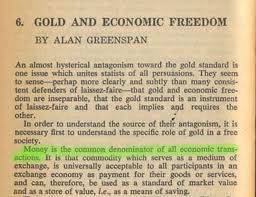 Throughout his career Greenspan hasn't exactly been shy about making his feelings about Au known. Further, Greenspan is a highly paid private consultant right now without any official government responsibilities or gag orders. He (and his clients) are no doubt aware that his words still carry significant weight in the marketplace, and he can say whatever he likes and even talk his own book.
Having said that, as a close student of Greenspan's philosophy and personality I can say with a high degree of certainty that he very much cares about his place in history, particularly at this stage in his career.
In other words, the likelihood that the former Chairman is going on television and talking up gold the past few years just to earn a few bucks from hedge funds is low, in my opinion. And with outgoing Fed Governor Thomas Hoenig also recently weighing in on the yellow metal's merits one can't help notice the growing chorus for a reconsideration of the gold standard.
Continue reading the full article published on SeekingAlpha here.
"We have at this particular stage a fiat money which is essentially money printed by a government and it's usually a central bank which is authorized to do so. Some mechanism has got to be in place that restricts the amount of money which is produced, either a gold standard or a currency board, because unless you do that all of history suggest that inflation will take hold with very deleterious effects on economic activity. There are numbers of us, myself included, who strongly believe that we did very well in the 1870 to 1914 period with an international gold standard."During the interview Greenspan also wondered aloud whether we really need a central bank.
Contrary to what the occasionally conspiratorial and always hyperbolic 'Tyler Durden(s)' of ZeroHedge would have you believe, these quotes (while perhaps deserving of a muted 'wow' from those hearing them for the first time) aren't nearly as big of a surprise as World Bank President Bob Zoellick's recent call for a return to the Gold Standard.
Having said that, as a close student of Greenspan's philosophy and personality I can say with a high degree of certainty that he very much cares about his place in history, particularly at this stage in his career.
In other words, the likelihood that the former Chairman is going on television and talking up gold the past few years just to earn a few bucks from hedge funds is low, in my opinion. And with outgoing Fed Governor Thomas Hoenig also recently weighing in on the yellow metal's merits one can't help notice the growing chorus for a reconsideration of the gold standard.
Continue reading the full article published on SeekingAlpha here.
Friday, January 21
Thursday, January 20
Video: On Why Becoming More Energy Efficient is Simply Not Good Enough

"Like salt, we need to strip oil of its strategic importance."
-Gal Luft, Executive Director of the Institute for the Analysis of Global Security and a founder of the Set America Free Coalition

The word 'independence' implies choice, and when it comes to an energy source for automobiles the vast majority effectively have zero choice.
For a long time now oil has had a monopoly as THE energy source used in vehicle transportation, and we must find a way to put an end to oil's stranglehold.
Luft's and coauthor Anne Korin's book, titled Turning Oil into Salt: Energy Independence Through Fuel Choice, argues for the importance of making oil as un-strategic a commodity as salt has become.
Many have forgotten or never learned that wars used to be fought over salt. The 'primordial condiment' as some have called it was one of the most effective ways to preserve food, making it perhaps the world's most strategic commodity.
 |
| Nissan Leaf |
Their book can be found in the Good Books and Films section on the right side of this blog.
Subscribe to:
Posts (Atom)